
How to Protect Workers from Dangerous Hexavalent Chromium
 Written by Matt Thompson, CSPUpdated October 3, 2026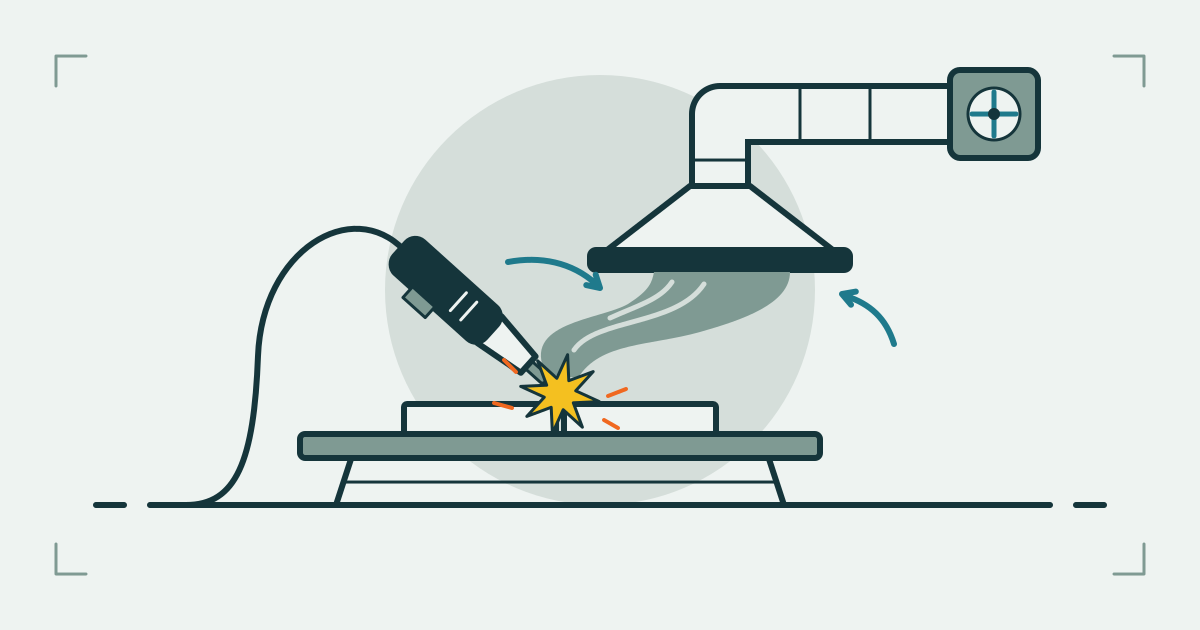
Hexavalent chromium, also known as chromium-6 (Cr(VI)), is a highly toxic chemical that is commonly found in industrial workplaces. Exposure to this substance can have serious health consequences, including lung cancer and other respiratory diseases. In order to protect workers from the dangers of hexavalent chromium, the Occupational Safety and Health Administration (OSHA) has established strict standards for its handling and use in the workplace.
OSHA's general industry standard for hexavalent chromium, 29 CFR 1910.1026, sets a permissible exposure limit (PEL) of 5 micrograms per cubic meter of air, calculated as an 8-hour time-weighted average (1910.1026(c)). Employers must use engineering and work practice controls, such as ventilation systems, to reduce and maintain exposure to or below the PEL unless they can demonstrate that such controls are not feasible (1910.1026(f)(1)(i)). The standard makes two exceptions to that rule: painting of aircraft or large aircraft parts in the aerospace industry, which has its own control level (1910.1026(f)(1)(ii)), and processes or tasks that the employer can demonstrate do not expose any employee above the PEL for 30 or more days per year (1910.1026(f)(1)(iii)). Where feasible controls are not sufficient to reduce exposure to or below the PEL, the employer must still use them to reduce exposure to the lowest levels achievable and supplement them with respiratory protection (1910.1026(f)(1)(i)). Respirators are also required in the other situations the standard lists, including emergencies (1910.1026(g)(1)). Where a hazard is present or is likely to be present from skin or eye contact, employers must provide appropriate protective clothing and equipment, such as gloves, at no cost to employees (1910.1026(h)(1)).
It is important for employers to ensure that their workers are properly trained on the hazards of hexavalent chromium and how to use PPE and respiratory protection properly. This will help to prevent accidents and protect workers from the harmful effects of this toxic chemical. By following OSHA standards and taking the necessary precautions, employers can help to create a safe and healthy work environment for their employees.
The effects of Cr(VI) on human health are well-documented and can be serious. Inhaling this chemical can lead to respiratory problems, including lung cancer and other respiratory diseases. Ingesting it can cause stomach ulcers and other digestive issues. Even coming into contact with it on the skin can cause irritation and other health problems.
Furthermore, each employer with a workplace or work operation covered by the standard must determine the 8-hour time-weighted average exposure for each employee exposed to hexavalent chromium (1910.1026(d)(1)). This is typically done through air sampling and testing. Employers should also have a written plan in place for dealing with accidents or spills involving hexavalent chromium, in order to minimize the risk of exposure and protect workers.
In conclusion, hexavalent chromium is a toxic chemical that can pose serious health risks to workers who are exposed to it. By following OSHA standards and taking the necessary precautions, employers can help to protect their workers and create a safe work environment. Regular air quality monitoring and a written plan for dealing with accidents are also essential for ensuring the health and safety of workers in industries where hexavalent chromium is present.
Read the standard itself at 29 CFR 1910.1026, or see OSHA's hexavalent chromium page for more resources.
Published by TSG Safety. This page explains the rules in plain English and is not legal advice. Browse all articles.